Octopath Traveler 2 Retrospective
Overdue
Although it would make more sense to talk about the recent release Octopath Traveler 0, I am regrettably behind the times and haven’t gotten to play it yet. I’m slowly catching up, however, and I want to talk about its predecessor instead: Octopath Traveler 2. I had been excited to play it ever since it was announced in 2022, and even more encouraged after seeing all the great reviews it received. Despite my eagerness, I was well-aware that this game would be a massive JRPG that I’d need to make time for. With so many other games already in my backlog, I wasn’t in a rush to play it. With that in mind, I left the game in my wishlist, keeping an eye out for any good sales. The stars aligned earlier this year, however, when I finally found a fantastic sale on the game and hit purchase. Despite a still-long list of games I wanted to beat in 2025, I managed to put 65 hours into it. Before I get into my full thoughts on Octopath Traveler 2, I want to talk about my experience with the original game, Octopath Traveler.
I have a love/hate relationship with the original Octopath Traveler (OT). When I played it on Switch back in 2019, I was instantly enthralled by the game’s incredible soundtrack and captivating combat. Until then, most of my turn-based combat experience came from the Mario & Luigi and Paper Mario series. I loved how Octopath Traveler expanded the turn-based formula I was used to. Discovering enemy weak points so I could break their shields and deal more damage forced me to slow down and analyze each encounter. This was elevated even more due to every character only having access to certain weapons and attacks: I needed to approach every battle differently depending on who was in my party at the time. Managing Boost Points (BP) added another layer of complexity to the combat. Should I use my BP to hit several times and break the enemy’s shields sooner, or should I hold on to it so I can do massive damage later? All of this combined with the stellar soundtrack and entertaining bosses made Octopath Traveler’s combat systems one of my favorites ever.
Unfortunately, the entire experience wasn’t all positive. As much as I enjoyed the combat, I eventually got overwhelmed with the number of battles I was required to do. Random encounters have never been my favorite mechanic in games, but I can usually overlook it. By the middle of the chapter 3s, I was fatigued by constant battles. It also didn’t help that I was never engaged in the characters’ stories. I vaguely remember enjoying each character’s introduction, but a ~4-month hiatus from the game right in the middle of everyone’s chapters meant I could barely remember what was happening. Despite my indifference towards all the stories, I still completed all of them, but I skipped nearly all the dialogue and focused on defeating the bosses instead. As for the true final boss, I attempted it a total of one 1 ☝️ time. I quickly accepted defeat once I realized how long I’d need to grind levels before having a chance at beating it. My divided thoughts on Octopath Traveler left me wanting another game that resolved my issues with it, and my prayers were answered with its sequel.
Choose your Character
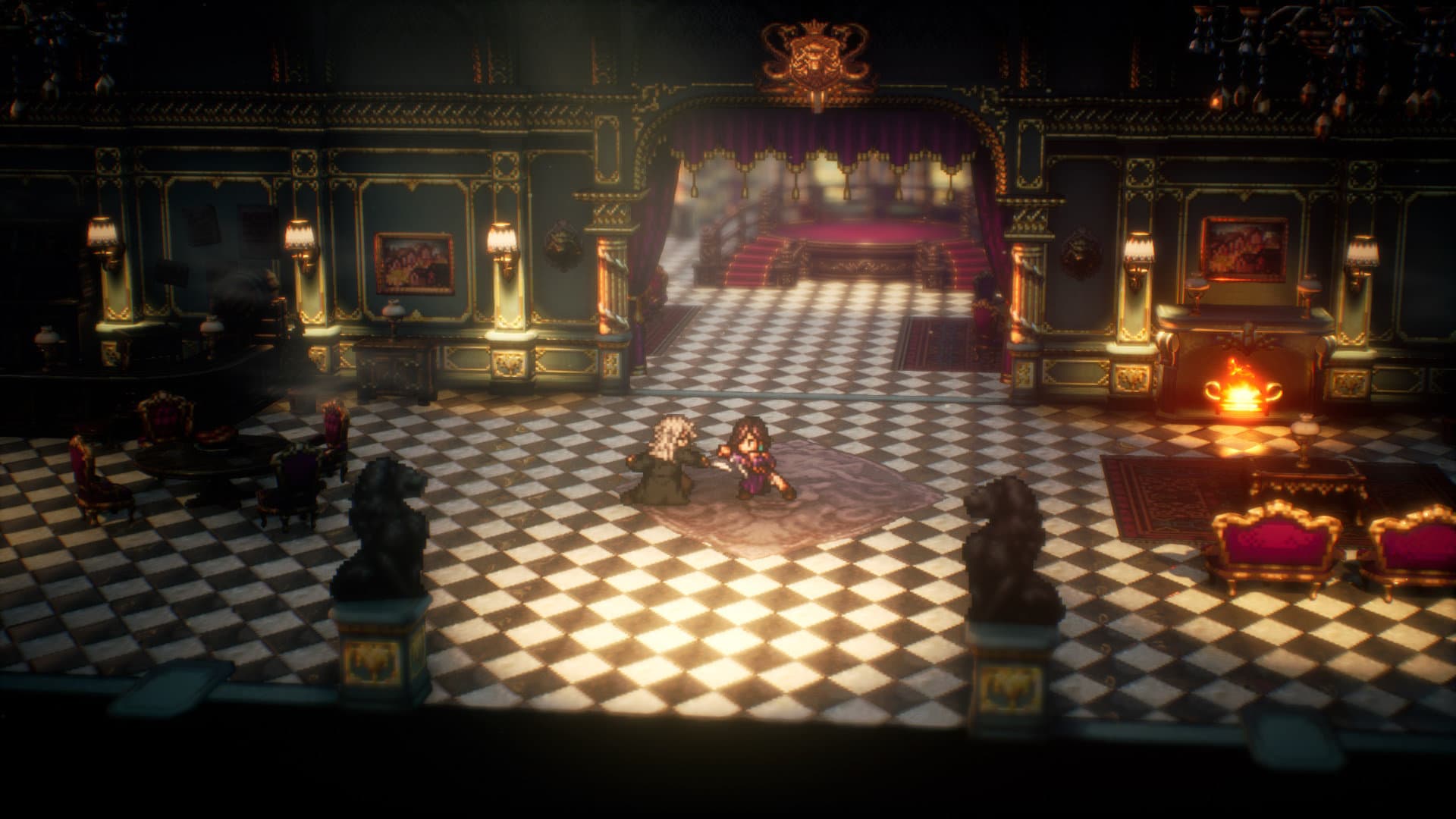
My Octopath Traveler 2 (OT2) journey began with the stoic thief, Throné. I loved Therion’s ‘steal’ ability in OT, so I knew I wanted to start with the Thief job. Throné set the bar high with her story of escaping the cycle of death her parents had shackled her to; I knew right away I had made a good decision choosing to start with her. Fortunately, Throné’s story was only the beginning as I’d soon learn that every character had an engaging story this time around. After completing Throné’s first chapter, I promptly set off in search of the rest of the travelers, obtaining Temenos, Osvald, Ochette, Castti, Hikari, Partitio, and Agnea. My renewed determination to appreciate every story, combined with the writers going all out, ensured I was hooked on every character’s story. Some of my favorite intro chapters were Osvald’s, the Scholar wrongfully imprisoned on a remote island for the deaths of his wife and daughter, and Hikari’s, the Warrior banished from his kingdom as it is overthrown by his malevolent brother. I appreciated the wide range of all eight stories; the mix of more lighthearted stories, like Agnea’s or Partitio’s, served as a good shift from the darker stories, like Osvald and Throné. A minor detail I also appreciated was how the developers didn’t stick to the “eight travelers, four chapters each” formula. Every character had a varying number of chapters, whether it was multiple route options or simply having a fifth chapter. Osvald, for example, has his first two chapters as soon as you meet him, but he ends up having a fifth chapter. Ochette only has three chapters, but her second chapter has three different routes so she technically has five chapters. Partitio fully had his own ‘sidequest’ chapters that helped flesh out his character. Not every route or chapter had a boss at the end, which I welcomed since it added a bit of realism to their stories. Overall, the intro chapters for every character successfully got me excited for the journey ahead.
Tactful Interactions
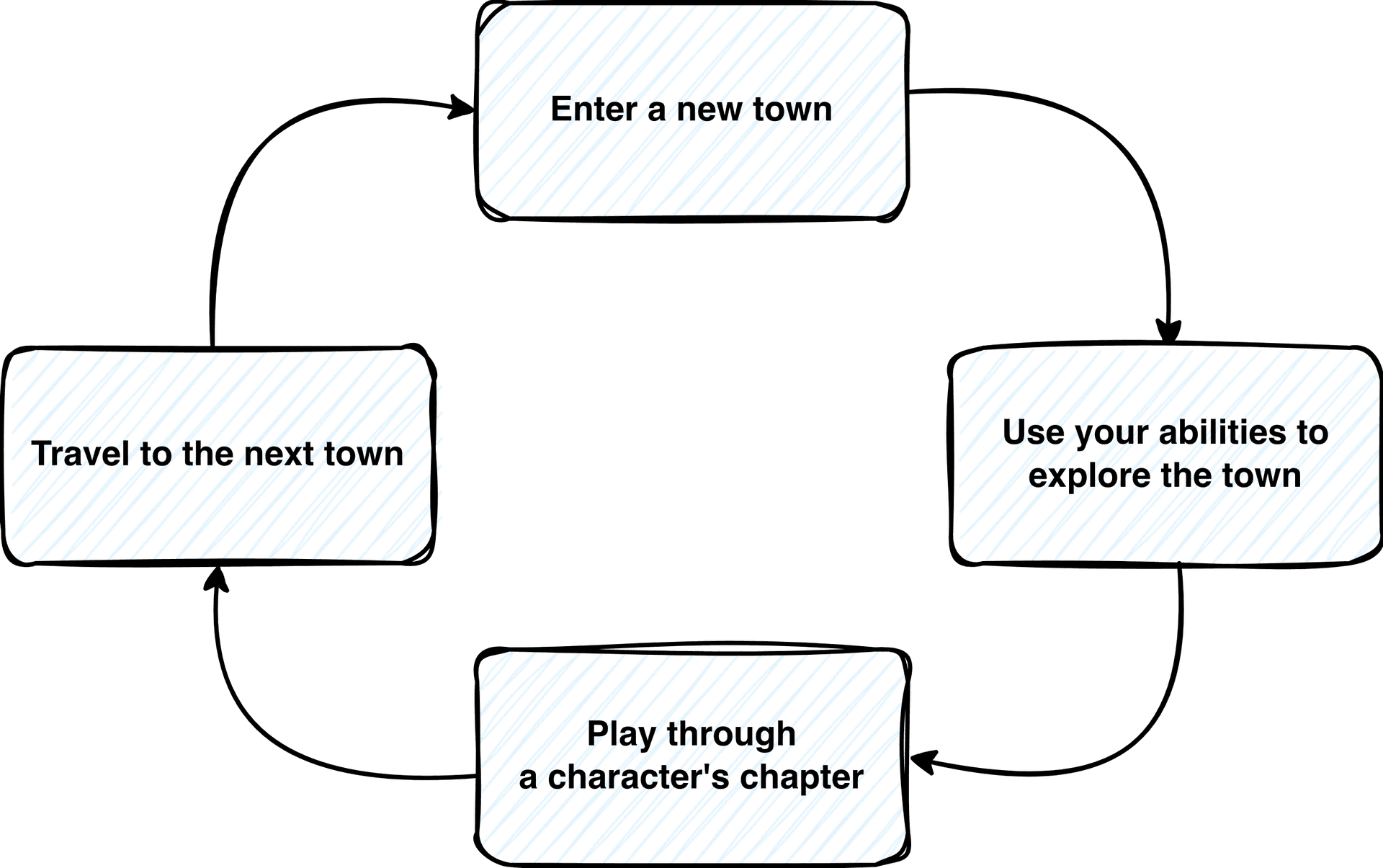
I’m a big fan of Octopath Traveler’s bite-sized game loop. The cycle of exploring towns, completing a chapter, and then navigating to the following town only takes about 1-1.5 hours to loop. Unlike other RPGs where I feel the need to set apart 3-4 hours to really get invested, it’s easy to convince myself to commit to a single game loop for an hour or so. I’d rarely play for only an hour though. It’s similar to Persona, where I tell myself I’ll only play a couple in-game days, and then I end up playing an entire month instead. Although it seems like a minor endeavor, using each character’s abilities in each town is one of my favorite parts of the game. Throné’s steal ability is one of my favorites. Every NPC in town has items on them, and you have a percent chance of stealing it from them depending on how rare the item is. You can also use Partitio’s purchase ability to simply buy items off a person, but I prefer to gamble on chance. I’m not convinced that the stealing percentages are accurate (I’ve failed an 80% chance too many times), but I need to do more research into it. The rest of the abilities from the first game all return, but new abilities are introduced as well thanks to the brand new day/night cycle. The day/night cycle made each town even more involved than the first game. Every character now has different abilities depending on the time of day. In addition to Osvald’s daytime ability to scrutinize NPCs, at night he’s also able to mug NPCs – challenge them in combat to take their belongings. These new abilities come on a spectrum from ‘always useful’ to ‘quest specific.’ For example, I would use Agnea’s entreat ability every chance I got to receive useful items from NPCs, but I would only use Temenos’scoerce ability when absolutely necessary. The minor overlap in some characters’ abilities urged me to think twice about how I approached every person in the town. Is it worth it to spend 10,000 leaves for Hikari to bribe info out of a character, or is there a chance Castti can inquire from them for free? Several of the playable characters are also able to summon NPCs to aid in battle, whether it be through the guide, befriend, allure, or hire abilities. Each town comes with a few sidequests to optionally complete, and they usually require using one of the characters’ abilities to solve a problem. From completing sidequests to using abilities on NPCs, shopping, and unlocking hidden chests, there was a plethora of things to do in every town before I even commenced a chapter.
Outstanding Views
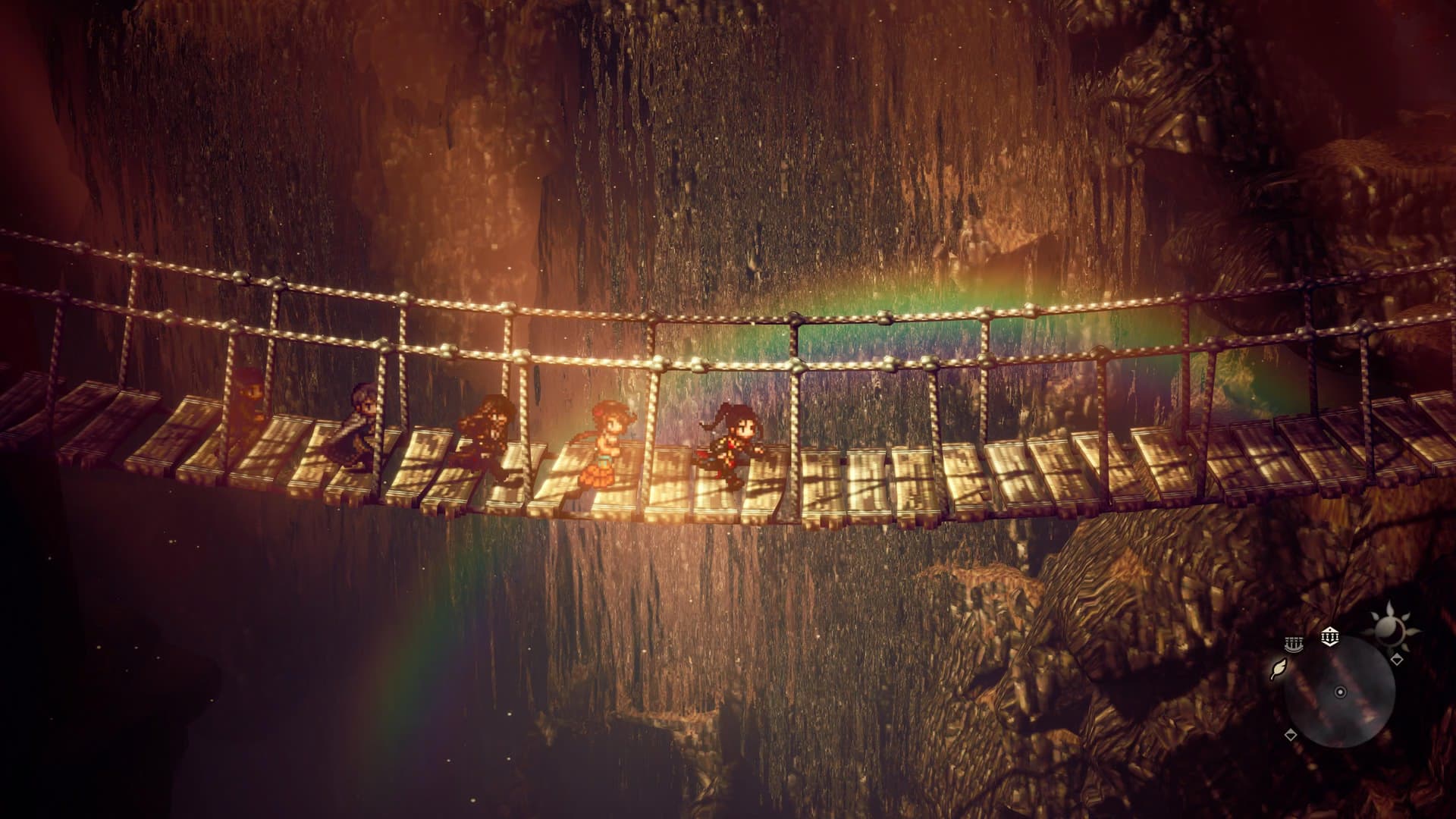
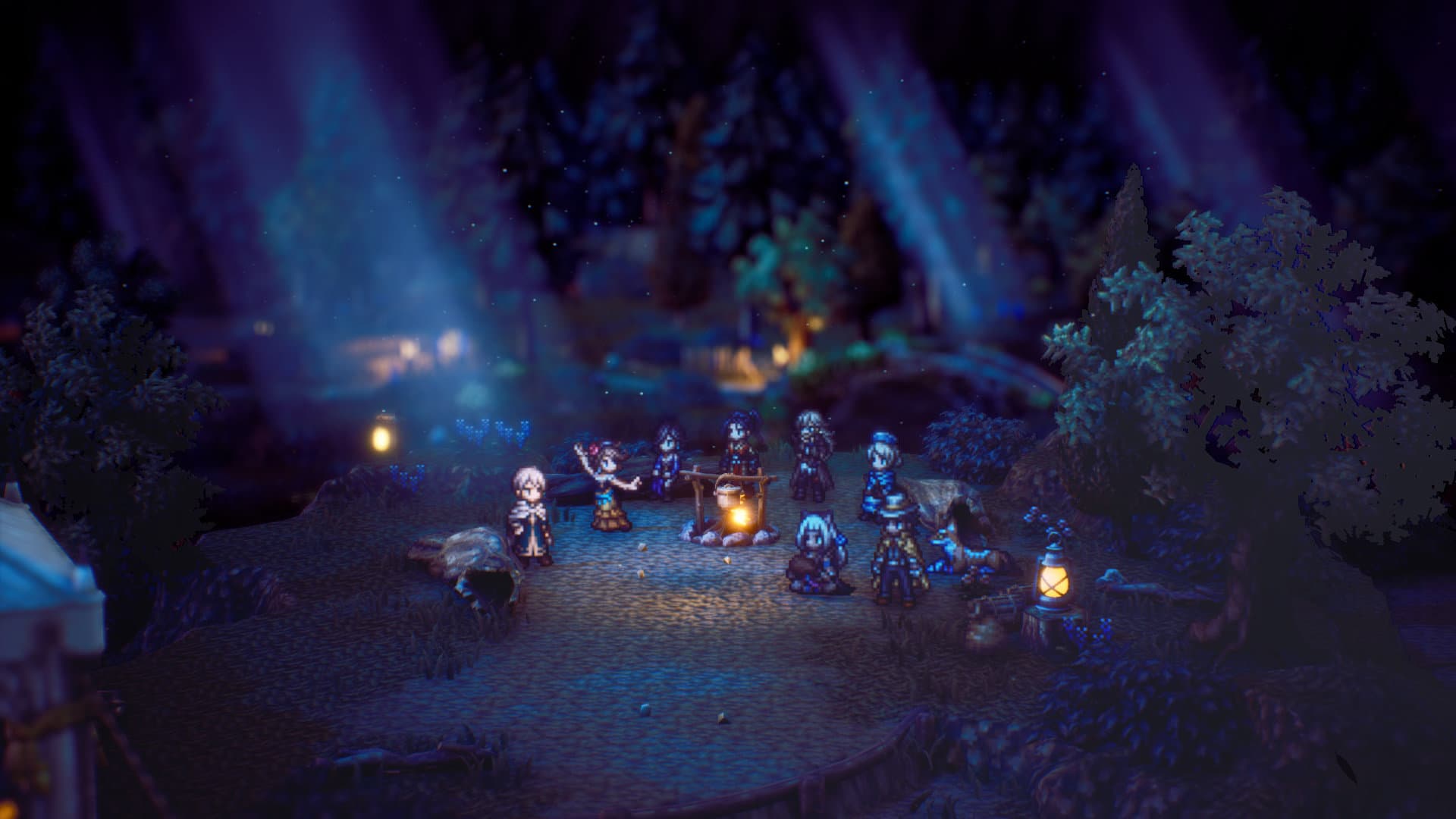
In addition to the wonderfully intricate cities, the rest of the overworld is just as interesting to explore. Every region comes with its own scenery, music, enemies, and secrets to uncover. The gorgeous HD-2D art style from OT returns in all its glory. The verdant green Leaflands, snowy Winterlands, and seaside Harborlands are all fully fleshed out and beautifully designed, making each environment visually stunning to look at. I’ll never forget roaming the Leaflands, crossing a bridge in front of a waterfall with a striking rainbow in the background. There were so many moments where I just stopped in awe of the world. The dynamic lighting in every area feels intentional, adding a distinct atmosphere to each location. The beauty doesn’t end on land. A bit over halfway through the game, you set sail across the ocean between the western and eastern continents. There are new enemies and bosses to defeat along with several islands and piers where you can anchor your ship. To top it all off, the entire feel of a region shifts once you flip to nighttime. The lighting changes from sunlight to moonlight, with various lamps or campfires to light the path. This is one of the most immersive pixel worlds I’ve ever delved into, and I believe the developers without a doubt mastered the HD-2D art style.
Protecting the Peace
When I started the original game doing Ophilia’s story, I struggled to complete her chapter since she was my only party member going up against two to three enemies at a time. I beat her 1st chapter boss eventually, but it was by the skin of my teeth and only after dying several times. I ran into this issue with a few other characters, since all of their first chapters require playing by themselves. I was pleased to see OT2 tackled this issue right out of the gate. Every character is either given access to a summon or has their own party members to aid them in their first chapter, so you aren’t forced to do any fights alone. This is just one of the ways OT2 improves an already amazing battle system. The turn-based combat keeps all the mechanics I loved from OT, such as job skills, Boost Points, and shield breaking. Every job now has a mix of returning skills, like the Hunter’s Leghold Trap, and brand new skills, like the Warrior’s Aggressive Slash. Swapping secondary jobs is still a vital part of the combat, and it’s been made even more seamless due to the addition of licenses. By completing guild tasks, you can obtain up to three licenses for each job, which means you can have an entire party of Warriors! I didn’t go out of my way to collect multiple licenses for every job, since I usually only wanted one of every job type in my party at a time. The character-specific EX skills you can unlock were interesting to find, but I didn’t end up using them often – especially since the second EX skill was only unlocked after completing a character’s story.
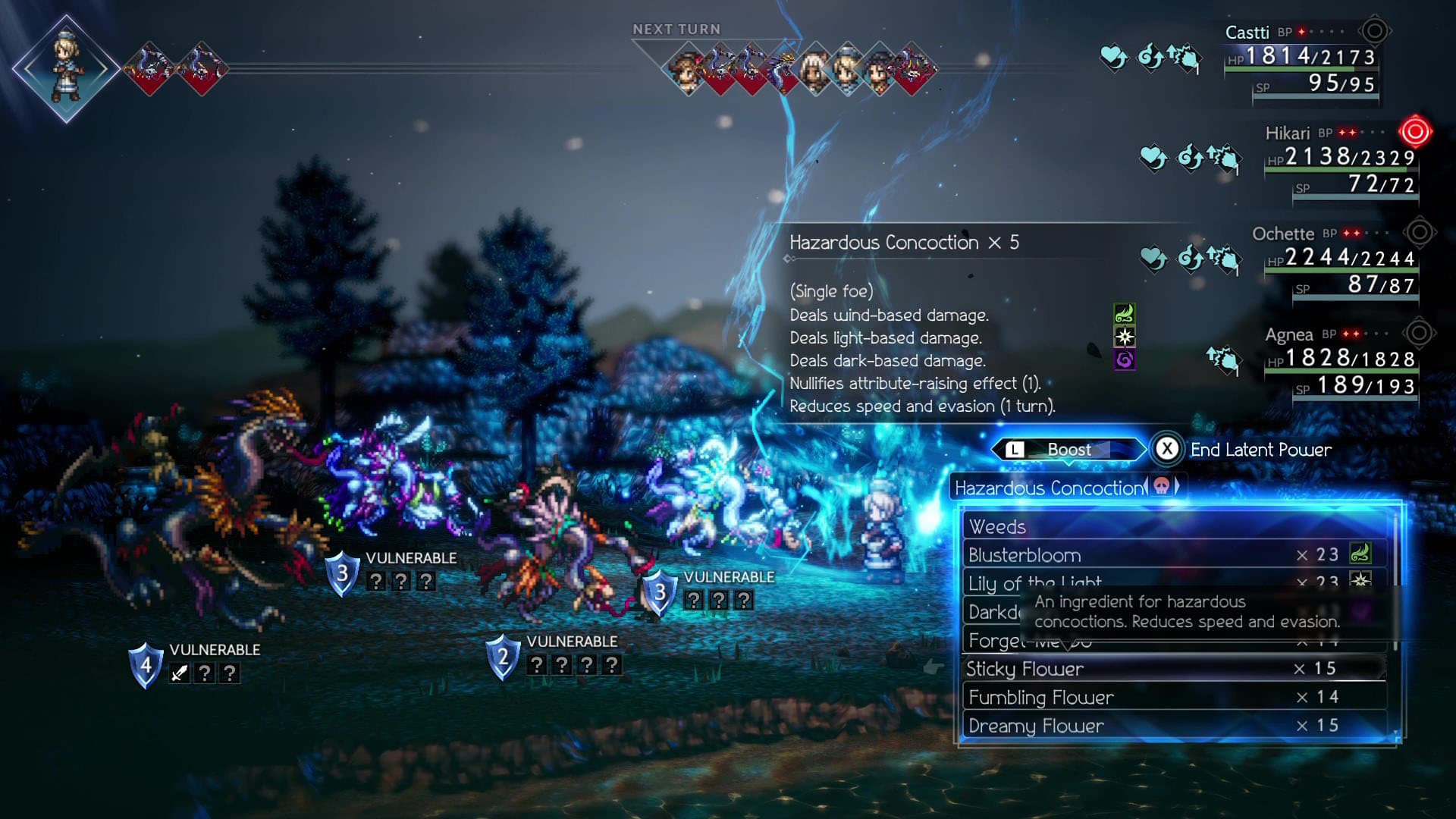
Character-specific abilities return in this game, but most of them have been tweaked. One of the biggest reworks is Castti’s concoct skill. In OT, Alfyn had access to dozens of herbs and was able to attack using every element, making him extremely overpowered with so many options to choose from. In OT2, Castti only has access to Wind, Light, and Dark elements, with a bigger emphasis on buffs/debuffs during battle. I think it was a good move to nerf the apothecary skill, while also giving her lots of synergy with other party members. Throné and Temenos both have nighttime-specific abilities, buffing the party and debuffing enemies respectively. Osvald’s Scholar ability to view one of an enemy’s weaknesses reigns supreme at the start of combat. The summon abilities are cute sometimes, but I usually would rather use a regular attack than spend a turn calling an NPC. This is not to be confused with Ochette’s Pokémon-esque capture ability that is still a lot of fun. OT2 introduces a fully new mechanic called Latent Power. Every character is given their own latent power that can be used once charged. I won’t list them all here, but some of my favorites are Throné’s power to immediately get a second turn and Partitio’s power to instantly receive max BP. My least favorite of the latent powers is probably Agnea’s power to make single target attacks hit all enemies, only because it isn’t as relevant during boss battles with a single target. These latent powers add another layer of complexity to an already involved combat system and make each battle even more engaging.
For all the praise I give OT2’s battle system, the most glaring gripe I have with the game is its difficulty. One of the aspects I loved about the first game’s combat was how difficult it was. I loved the chapter and advanced job bosses – they were always tough, forcing me to pull out every trick in the book and making each battle more exhilarating. In OT2, I barely struggled with any bosses. I gave the first couple chapter bosses a pass since it was still in the early game, but as I got deeper into the game, I noticed it wasn’t becoming particularly more challenging. I haven’t looked into other people’s reviews, but this could be because I never skipped any battles, unlike the first game. As I mentioned previously, I started speedrunning the first game to get it over with as soon as possible, meaning I was under-leveled for many fights. For OT2, however, I was much more patient, doing every battle and ensuring that I stayed around the recommended level for each chapter. It didn’t help that I could never remove Throné from my party, so she was always ten or more levels above the rest of the travelers. I think the difficulty issues also partially come from balancing issues, with attacks like Enervating Slash and Aeber’s Reckoning doing massive amounts of damage, one-shotting most chapter bosses. Partitio’s Hired Help skill is also really strong, since the strongest attack only costs 30,000 leaves (chump change in the late-game), and deals nearly 40,000 damage. Every boss was basically pay-to-win. All of my complaints with the difficulty are rather minor since I still had a good time battling enemies, and there were still a few bosses that gave me more than enough trouble.
Attuned to the Melodies
As some of you may already know, the most important aspect of any game I play is its music, and Octopath Traveler 2 has one of the most impressive soundtracks I’ve heard in a videogame. The game’s official OST on Spotify hosts a total of 131 tracks. I’m obsessed with so many tracks in the game. The first track that really caught my attention was the boss theme Critical Clash II, since it instantly made the chapter bosses more intense. The main theme perfectly captures the feeling of embarking on an ambitious journey, and I think it sounds similar to the first game’s main theme while still keeping its own personality. I also fell in love with nearly all the overworld themes. Leaflands, Harborlands, Seaside Town, and A Verdant Wind Blows are all mainstays in my videogame music rotation, beautiful melodies that make their areas come to life. Every location also comes with a -Night- version of the track – a more somber version with majestic vocals to back them up. There have been several days at work where I just let the soundtrack play from beginning to end, moving through every region. The best part of the soundtrack in my opinion is the character motifs. All eight characters have their own themes that usually play at the end of their chapters. Each traveler has a ‘theme’ connect to and describe their story: Ochette/Legends, Castti/Memories, Throné/Freedom, Osvald/Revenge, Partitio/Happiness, Agnea/Hope, Temenos/Truth, and Hikari/Kingship. These story themes are used in a more dramatic version of their tracks, called “In Pursuit of Legends/Hope/etc.” These motifs are also used in their final boss themes, aptly named “The Journey for Freedom/Truth/etc Ends.” I get a burst of serotonin every time I hear their motifs in the endgame. I could go on and on talking about my favorite tracks from this game, but I’ll finish here by saying my current top 3 songs from OT2 are Song of Hope, Critical Clash II, and Those Who Deny the Dawn.
Traveling Together
A satisfying ending is difficult to achieve in any narrative, and the structure of this game demanded a fulfilling finale eight times over. In Ochette’s final chapter, she returns to Toto’haha with the legendary creatures in tow, ready to protect the island from impending doom. Her ultimate opponent is either the ferocious beast Lajackal or the imposing avian Malamaowl, depending on which one she didn’t choose at the start of her story. She discovers that the creature has been seething with envy and frustration ever since it was overlooked. After a lengthy battle between Legends, the beastlings and humans unite to defend their home and agree to work together forevermore. Meanwhile, on the other side of the world, Osvald finally catches up to Harvey to exact his Revenge and rescue his daughter, Elena. Both having uncovered their own versions of the “One True Magic,” they engage in an intense showdown to determine whose power is genuine. Harvey is ultimately consumed by dark magic and defeated, while Osvald triumphantly walks away with Elena. He leaves her in the care of his assistant before returning to the world at large. Initially, I didn’t like that his story ended without him speaking to Elena in the aftermath, but after completing the game’s final quest, I understand the choice.
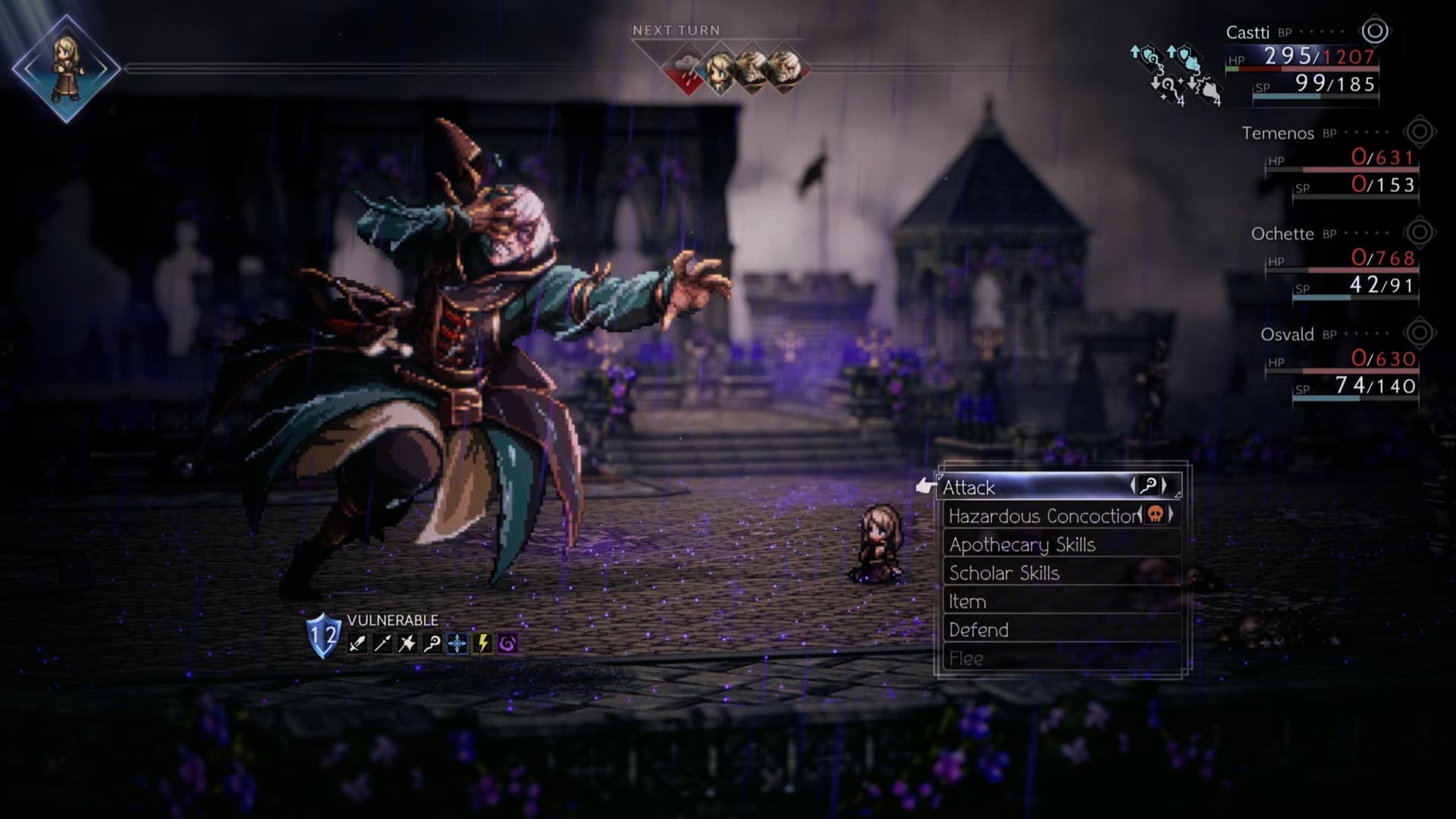
Castti’s third chapter concludes with the recollection of her Memories in one of the most heartbreaking scenes in the game. We learn that her longtime friends in Eir’s Apothecaries all sacrificed their lives to save Castti from Trousseau’s poisonous rain, allowing her to find a cure to save the rest of the world. With that gut-punch of an ending, Castti’s final chapter picks up in the city of Timberain, Trousseau’s next intended target. After evacuating the city, the party confronts him on a rooftop, with his toxic smoke already filling the air. This battle was by far the most difficult for me of all the final bosses. Trousseau has massive health and several powerful concoctions that damage the entire party. On top of that, the toxic rain slowly reduces the travelers’ max health, creating a tense urgency to finish the fight quickly. Trousseau meets a fitting end when Castti concocts one final mixture that neutralizes the effects of his poison rain. At last, Castti can breathe a sigh of relief, knowing the world is safe from Trousseau’s malice and her friends’ sacrifices were not in vain.
In a staggering feat, Partitio amasses 38 billion leaves to purchase Roque’s steam engine. Unsurprisingly, Roque refuses to hand it over and uses the world’s first steam train to attack the travelers. The party manages to give him a thorough beating, and Partitio finally convinces Roque of his erroneous ways. With his heart changed, Roque joins Partitio in forming the Partitio & Roque Company, making the steam train accessible across all of Solistia and spreading Happiness far and wide. Meanwhile, Temenos’s pursuit of the Truth reaches its climax in his final chapter. After Crick’s tragic death, he left behind a crucial clue that guides Temenos to Kaldena, captain of the Sacred Guard. She had been masquerading as a member of the local religion, the Order of the Sacred Flame, with plans to use the Book of Night to summon the Shadow. Temenos confronts her now-monstrous form in a desolate cave, and she is ultimately vanquished after losing control of the Shadow’s power.
We return to Hikari’s hometown of Ku in his final chapter, where he seeks to reclaim the city from his brother, Mugen, once and for all. All the allies Hikari has gathered throughout his journey rally at his side, fighting through Mugen’s forces so the travelers can reach him. The climactic showdown against Mugen unfolds across three phases, each more demanding than the last. Amid the chaos, Hikari is forced to confront the Shadow within himself in a decisive duel for his mind. Against all odds, Mugen is defeated and Ku is liberated from his tyranny – a fitting beginning to Hikari’s Kingship. Across the ocean, Agnea takes the stage against Dolcinaea to determine who truly deserves the spotlight. Dolcinaea’s battle introduces several inventive twists, summoning the audience to aid her and even luring party members to her side. In the midst of the performance, Agnea unveils her Song of Hope – the song she’s been composing throughout her journey. Her singing replaces the standard final boss theme during Dolcinaea’s second phase and ultimately carries the party to victory, cementing Agnea as the greatest star in Solistia. I wasn’t convinced I would enjoy Agnea’s story in its early chapters, given its simple premise. However, I was won over by her unwavering determination to show the world how vital it is for Hope to shine, even in the face of overwhelming darkness.
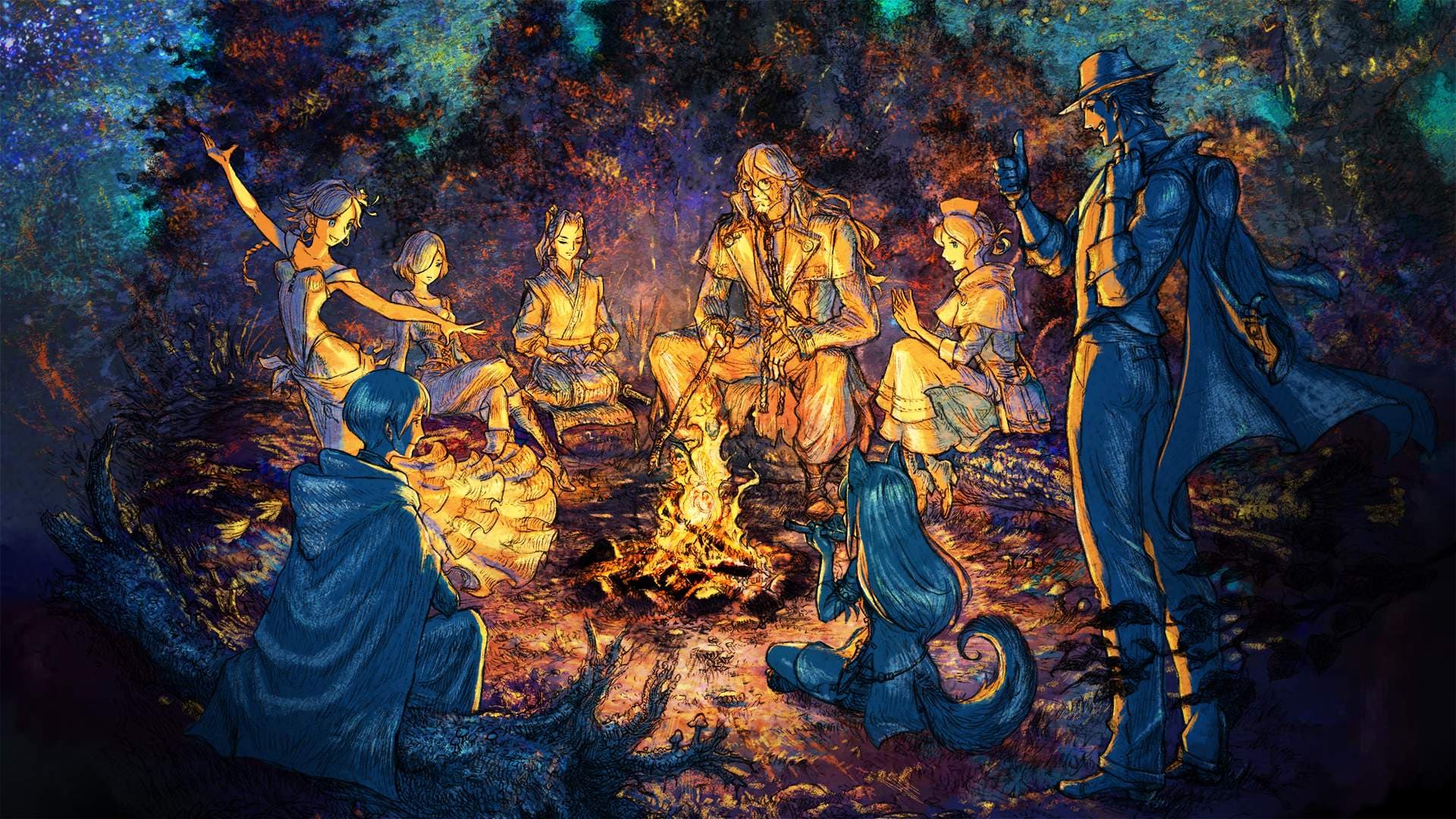
Throné’s final chapter is by far the most disturbing of all eight travelers. After retrieving both keys from her parents, she returns to her hometown in search of her true father. Those keys open a hidden passage leading to Lostseed, an isolated and deeply unsettling town shrouded in fog and populated by ghostly husks known as “vessels.” Within Lostseed’s castle, the travelers encounter Claude, a silver-haired, egotistical sociopath who has lived for centuries. He reveals himself as Throné’s true father and the progenitor of dozens of her Blacksnake brethren. Claude spent his long life impregnating countless women in a cold, obsessive attempt to create a vessel capable of killing him, showing no regard for the lives he destroyed along the way. Enraged and repulsed, Throné and the others confront him in battle. Claude proves to be a nightmarish foe, capable of shackling the party’s primary jobs and tormenting Throné with phantoms from her past. Even so, his cruelty is not enough to stop the travelers. They defeat him, proving that Throné was the vessel he had been waiting for all along. After Claude’s death, Throne finds the final keys on his body and at last removes the collar from her neck, finally attaining the Freedom she had sought for so long.
Homebound
I’m super happy that this game gives more attention to the interactions between the travelers throughout all their chapters. In the first game, the eight travelers didn’t interact at all outside of combat; it was as if they were total strangers traveling together for unclear reasons. The cast is much more tight-knit in this game. All the party members have one-on-one conversations about various things in each other’s chapters, and there’s extra conversations between three party members in the taverns. I loved watching them connect with each other in these heart-to-hearts and learn a new perspective from the other person. OT2 also has tag-team chapters where Hikari/Agnea, Osvald/Partitio, Throné/Temenos, and Ochette/Castti work together to delve into the mysteries of Solistia, giving them even more opportunities to bond with each other. This all culminates in a final quest after you complete everyone’s stories called “The Journey for the Dawn.” In this segment, the entire world is covered in darkness, and you’re no longer able to switch to daytime. The entire party comes together as one team to discover how this happened and defeat the wicked god, Vide once and for all. The final battle rivals the first game’s true final boss in difficulty and is probably the most invigorating boss fight in the game. Sadly, I have yet to defeat this final boss, but rest assured I fully intend to return and see it through to the end.
Octopath Traveler 2 exceeded all of my expectations as a sequel to Octopath Traveler. It boldly builds on its foundation while also addressing the issues I had with the original game. Even after 65 hours, there’s still so much I have yet to do. I haven’t done most of the sidequests, collected all the licenses, and most disappointingly, unlocked all of the hidden jobs yet. I assumed I would simply stumble across them like I did in the first game, but it seems like I’ll have to do a bit of research to find them. Regardless, I am more than satisfied with everything I’ve experienced. I have a soft spot for all the travelers. None of their stories are particularly groundbreaking, but I enjoyed all the stories nonetheless. One of the stories even made me cry unexpectedly (Castti’s Chapter 3), while I never came close to tears in the first game. I’m looking forward to finishing out the game and eventually playing Octopath Traveler 0, but I can’t see how any future Traveler game could top this one.
Jose Folgar 12/30/2025